California Watch map mashup of schools on fault linesNieman Journalism Lab scored a coup in landing the eloquent and insightful Ken Doctor as a weekly columnist focusing on the economics of news. His analysis of the cost of journalism at California Watch is well worth reading if you want to understand why nonprofit investigative ventures are so popular right now (ProPublica just nabbed its second Pulitzer).

California Watch’s “On Shaky Ground,” an account of the dangerous vulnerability of many California schools to collapse in the event of an earthquake, is “old-fashioned, shoe-leather, box-opening, follow-the-string journalism, and it is well done,” Doctor says. It also cost over a half million dollars to report, an amount that would have caused most newspaper publishers to gulp even before the industry entered its string of 21 consecutive quarterly revenue declines.

But a half million is a relative bargain when you consider the number of media organizations that benefited from it. Pieces of the series ran in six major dailies and were picked up statewide by ABC-affiliate broadcasters. Top public radio stations in the Bay Area and Los Angeles ran with it, and a number of ethnic and online outlets (including more than 125 Patch sites) also picked up the coverage. Many localized the content by snipping local maps or extracting information about their area from the voluminous database of school-by-school information that the project produced.

Doctor notes that California Watch is building a new kind of syndication business around investigative journalism, which is the branch of news that has been hardest hit by budget cuts over the last three years. This is not a reincarnation of the Associated Press model, which mainly delivered breaking news. Bloggers, citizen media and Twitter have diminished the value of that function considerably. What citizen journalism can’t do it spend 20 months developing a story, which is what California Watch did.

California Watch is still “feeling its way along,” in Doctor’s words. Syndication revenue won’t support its current $2.7 million annual budget, so donations are grants are still essential to its livelihood. But look at what donors get for their money: About 70% of that $2.7 million goes to support the project’s 14 journalists. By comparison, a typical daily newspaper’s editorial costs are about 20% of overall expenses. These nonprofit models are vastly more efficient than the newspaper investigative teams they’re replacing.

And when you spread those costs among a lot of subscribers who pay a few thousand bucks a year to get access to the reports, it’s really not that expensive. “An owner…can hardly reject the offer of paying one-hundredth of the cost for space-filling, audience-interesting content,” Doctor writes. Particularly when compared to the value of a single child’s life who might have been saved (hearings are already under way).

Doctor’s analysis raises an important point about the evolving economics of information. In a world in which raw data has become a nearly valueless commodity, value is derived from filtering and contextualizing information for specific audiences. The small California weekly that could never dream of spending a half million dollars on an investigative project can spend a few hundred dollars to buy the work of a dedicated investigative team and then extract the information that’s relevant to its readers.

This is a much more efficient way to deliver news, but taking advantage of it requires discarding treasured assumptions like the not-invented-here syndrome and the belief that scope and scale define importance. It’s good news for local publishers. In the traditional model, only a handful of California papers could have tackled a project the size of On Shaky Ground. Now nearly everyone can share the wealth.

The Long, Slow Bleed

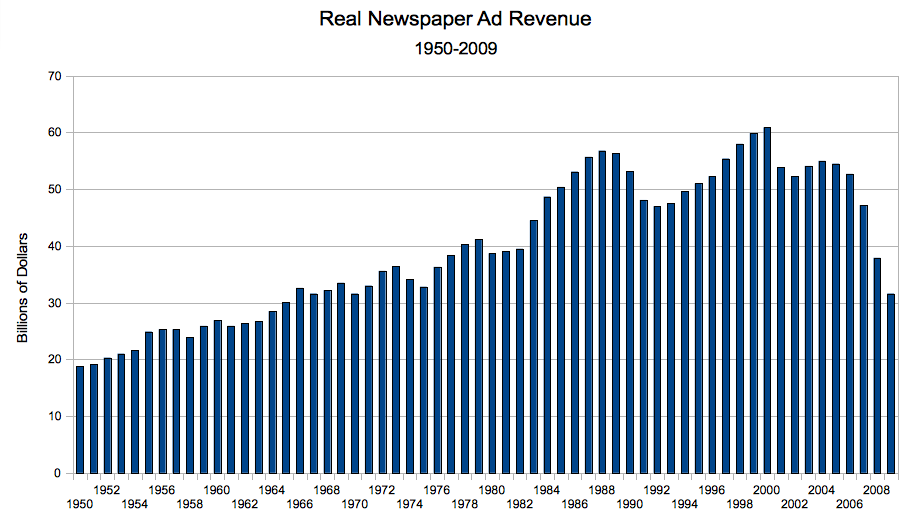
Newspaper ad revenue forecastLest anyone think the lack of major metro daily closures over the last couple of years is a sign of strength in the newspaper industry, consider recent earnings reports. Ad revenues at Gannett, McClatchy, Media General and Journal Communications were all off between 6% and 11% in the first quarter, and there’s no sign of a turnaround. Alan Mutter’s analysis makes an important point about why newspaper advertising isn’t sharing in the sputtering recovery.

The more advertisers of all types experiment with Web, mobile and social advertising, the more they will come to appreciate the power of the digital media to tightly target qualified prospects while granularly measuring the costs and effectiveness of their campaigns.

In sales jargon, the buying process is a funnel, with a large number of uninformed prospects at the mouth and a few qualified buyers at the tip. As consumers increasingly research their purchase decisions online, the need for merchants to advertise their availability declines. They get more leverage from intercepting buyers during the decision-making process. The deeper into that process buyers get, the better the prospect of converting them to customers. And incidentally, vendors only have to pay for actions like clicks and leads, not vague measures  like circulation.

The reason newspaper closures have largely stopped is that the industry’s near-death experience in 2008 – 2009 focused publishers on slashing costs, raising subscription prices and squeezing as much blood as possible out of the stone of an aging and shrinking circulation base. That is not a prescription for growth. We continue to stand by our 2006 prediction that major metro daily print newspapers will all but disappear by 2025. In fact, we think it’ll happen sooner than that. It’s just that death will come from cancer, not heart attack.

Miscellany

The Las Vegas Review-Journal is expanding its business model beyond pure advertising. according to a press release,  a partnership with parent company Stephens Media LLC’s digital arm will enable the Review-Journal to launch a service to  provide local businesses:

…full website, branding and logo design; hosting and customer support for websites and related digital services; email marketing; mobile marketing; training to provide local businesses easy tools to maintain and update their own sites and analyze web traffic; search engine optimization and search engine marketing; customer reputation management with daily reporting; social media presence and tracking tools for digital and traditional marketing efforts to ensure monitoring of ROI.

Hmmm, why didn’t we think of that?

Desperation often drives innovation, and the miserable state of the Las Vegas economy no doubt played a role in this quest for new revenue sources. We think it’s a smart move; most small businesses have no idea how to market themselves online and a local newspaper is a trusted partner that’s in a great position to give them a hand.

AOL’s Patch network of hyperlocal news sites intends to recruit 8,000 bloggers over the next few days. It’s asking each of its 800 sites to sign up 10 community members to blog. No word on whether the contributors will be paid, but given that Arianna Huffington is now running the show, we think we know the answer to that one.

And Finally…

Typewriter typebarsReports emerged in the Twittersphere early this week that the world’s last manufacturer of mechanical typewriters was closing down its India production plant. A lot of people, including us, were taken in by this. But there’s good news for the old-timers who still appreciate the clatter of metal on paper. Atlantic Wire reports that several factories in China, Japan and Indonesia are still manufacturing typewriters. Even if production shuts down, there’s a pretty good used market. For old time’s sake, we bought an IBM Selectric, which used retail for $450 in the 1970s, for a buck at a yard sale a couple of years back. We’re still not sure what to do with it.

By paulgillin | March 29, 2011 - 6:41 am - Posted in Business News, BusinessModel, Circulation, Demographics, Newspapers, Paywalls, Solutions

The pundits (ourselves included) just can’t get enough of analyzing, trashing and otherwise second-guessing The New York Times‘ new online subscription plan. Here are some recent posts we noticed.

Steve Outing Pretty Much Trashes the NYT Paywall

For starters, it’s too expensive. The $15/mo minimum makes the Times all but inaccessible to cash-strapped young readers, which happen to be the people the paper most needs to engage. He also hates the defensive posturing publishers are using to justify subscription fees: “We need to do this to survive.”

Now THERE’s an incentive to customers to support you: Tell them if they don’t, you’re going to go out of business. How’s that working out for you, General Motors?

Outing points to the Times‘ own David Carr as the source of the right price: $4.99/mo. Respondents to Carr’s defense of the paywall plan posted on nytimes.com repeatedly refer to that fee as one they can swallow. Is anyone upstairs listening?

How To Hack the New York Times Paywall … With Your Delete Key

Mashable reports a new way to easily breach the paywall: “Readers need only remove “?gwh=numbers” from the URL. They can also clear their browser caches, or switch browsers as soon as they see the subscription prompt. All three of these simple fixes will let them continue reading.”

The NYT’s Melting Iceberg Syndrome

Frédéric Filloux suggests that The New York Times could improve its profitability by going to Sunday-only publication and forgetting about the other six days of the week, at least in print. “Sunday circulation is 54% higher than on weekdays…Sunday copy sales bring five times more money than any weekday…Some analysts say the Sunday NYT accounts for about 50% of the paper’s entire advertising revenue.”

If the Times could cut more than half its expenses by eliminating six days’ worth of print, it could theoretically make more money by publishing less frequently.

We also liked Filloux’ use of an iceberg as the analogy for a business that’s collapsing from within: “As an iceberg melts, the resulting change of shape can cause it to list gradually or to become unstable and topple over suddenly.” See any similarities to what’s happening to print?

A Big Op to Upgrade Op-Ed at New York Times

Alan Mutter believe the departure of Times columnists Frank Rich and Bob Herbert presents an historic opportunity for the Old Gray Lady to become the amazing technicolor dreamcoat of diversity of opinion. If Times‘ columnists are so smart, how come they missed the historic events going on the Middle East? Mutter asks. That’s what happens when your world is limited to Manhattan and the Beltway.

“Instead of dedicating the bulk of its limited and precious op-ed space to another generation of slightly more diverse Pooh-Bahs, the Times should publish the best of the online conversations in its print editions,” the Newsosaur recommends. That would be both good journalism and good promotion for the Time’s pricey paywall.

New York Times Digital Subscriptions: The Unofficial FAQ Updated

PaidContent.org has a useful rundown of the ins and outs of the Times‘ paywall, including pricing tiers, thresholds and platforms. Can you get a family account to nytimes.com? You’ll just have to read this FAQ to find out.

From the Onion: NYTimes.com’s Plan To Charge People Money For Consuming Goods, Services Called Bold Business Move

“In a move that media executives, economic forecasters, and business analysts alike are calling ‘extremely bold,’ NYTimes.com put into place a groundbreaking new business model today in which the news website will charge people money to consume the goods and services it provides.”

By paulgillin | March 18, 2011 - 9:05 am - Posted in Business News, BusinessModel, Newspapers, OnlineMedia, Paywalls, Solutions

We were so choked with joy to finally read details of The New York Times‘ paywall plan, which was announced yesterday, that we didn’t quite know what to say. So we’ll let others do the talking:
“This is how it will work, and what it means for you:

  • On NYTimes.com, you can view 20 articles each month at no charge, [after which] we will ask you to become a digital subscriber.
  • On our smartphone and tablet apps, the Top News section will remain free of charge. For all other sections, we will ask you to become a digital subscriber.
  • The Times is offering three digital subscription packages that allow you to choose from a variety of devices.
  • All home delivery subscribers will receive free access to NYTimes.com and to all content on our apps.
  • Readers who come to Times articles through links will be able to read those articles, even if they have reached their monthly reading limit.
  • The home page at NYTimes.com and all section fronts will remain free.”

Arthur Ochs Sulzberger Jr.

New York Times paywall notice


On day one, at least, opinion on the web seems widely negative—although, perhaps it’s just that the angriest people are the ones that we tend to hear from first? The Guardian, whose management has long defended the free-for-all model, is conducting a poll on its website, asking readers about the Times online, ‘Will you become a subscriber?’ I guess I shouldn’t have been so surprised that the ‘No, I’ll read my 20 free articles and move on’ would get a whopping 93 percent, with only 7 percent (as of this writing) voting for ‘Yes, its news and opinion are a must-have.’”

Columbia Journalism Review


“It’s a high price, a gamble, and a big hedge…against print subscribers migrating too quickly to the tablet. Since it is not charging print subs, it’s going to be an uphill battle to get non-print people to pay a minimum of $195 a year for something that was free, and it eschews conventional wisdom that $9.95 a month is a consumer limit on many digital items. The lack of an annual offer is glaring, and makes it far less friendly to expense accounts for business readers.”

Ken Doctor on Nieman


“An apparent (and likely very purposeful) loophole in The New York Times paywall plans: At least two of the newspaper’s home delivery subscription packages—which also come with unlimited access to the NYTimes.com website and apps—are cheaper than the “all digital access” subscription package.”

PaidContent.org


“This won’t work.”

Cory Doctorow on BoingBoing


“I suspect twenty free stories is too high, particularly when combined with the porous backdoor from social media. But it’s better to start off high and then gradually adjust it as the data comes in and you see what the effect is. And that’s a key thing to remember here: This is just a start.”

Columbia Journalism Review


“Nobody disputes the assertion that the Times cannot survive without increasing its revenues. Because I need the Times in my life—to read and to bitch about—I have no problem with the paper ejecting as many free-riders as necessary and soaking as many of the habituated (you’re looking at one) to make the paper prosper. So as we pick the mortar from the paywall and heave the loose bricks over the top at the Times noggins, keep this in mind: The pricing scheme and process by which the paper evicts its millions of squatters doesn’t have to be perfect, it just has to increase revenues appreciably.”

Jack Shafer on Slate


“There’s a great big hole in that wall that the Times doesn’t mention in its FAQ or press release. According to sources close to the situation, the 20-story limit can be breached if you access the site from multiple devices, and/or if you delete your cookies. In other words, suppose you hit the wall on your PC. Then move to your laptop, where you’ll get another 20 stories. Delete your cookies on any computer, and the clock goes back to zero.”

Bill Grueskin on PaidContent.org


“We believe at least 500,000 people (or more than 10 percent of those heavy users) may be willing to pay up—and here’s how we get to that number…”

PaidContent.org


“Let’s say that realistically the NYT is going after a universe of no more than 800,000 people that it’s going to ask to subscribe. And let’s be generous and say that 15% of them do so, paying an average of $200 per year apiece. That’s extra revenues of $24 million per year. [That] is a minuscule amount for the New York Times company as a whole; it’s dwarfed not only by total revenues but even by those total digital advertising revenues of more than $300 million a year. This is what counts as a major strategic move within the NYT?”

Felix Salmon on Retuers


“We asked some of our favorite media thinkers…to weigh in on the model’s pricing, packaging, and more. (Also asked: Are you going to subscribe?) Here are reactions from Steven Brill, Steve Buttry, David Cohn, Anil Dash, Jason Fry, Dan Kennedy, Martin Langeveld, Megan McCarthy, Geneva Overholser, Jonathan Stray, and Amy Webb. And please do share your own thoughts and reactions, as well.”

Nieman Journalism Lab


Poynter’s Julie Moos aggregates some of the best tweets from journalists and people in Canada, where the paywall will be tested first.


The New York Times communications staff emailed out this slide deck to media writing about their new paywall plan. (And trust me, we’ve been writing about it.) The deck lays out the basics of the plan, but also gives an idea of the pitch is meant to read to advertisers and investors, not just readers.”

Nieman Journalism Lab


“How about this, New York Times: You bring back the ‘On Language’ column, and I’ll take out a digital subscription.”

John McIntyre


Readers who come to Times articles through Twitter will be able to read those articles, even if they have reached their monthly reading limit. A new Twitter account has been set up with the apparent intention of making most or all of the nytimes.com website available this way: @FreeNYT Everywhere


“[The plan is encouraging] for two main reasons: firstly, it recognizes the importance of distribution in online publishing. If you erect an arbitrary paywall, many people will not bother to link to you because they don’t want to frustrate their friends….Secondly, it recognizes that they need to balance quality with quantity. Online advertising has yet to settle into any sort of pattern, but metrics of engagement are rising in importance, and one of those metrics is how much traffic comes from recommendations, i.e. social media.”

Online Journalism Blog


“From my office in Cambridge, I created a new dummy nytimes.com account and logged onto a Canadian proxy — a server that allows you to appear to a website to be coming from somewhere you aren’t. Then I went a-click-click-clickin’ all over nytimes.com, hoping to run into the 20 article limit. When I hit No. 20, this popped up in the lower-left corner of my browser window:”

Joshua Benton on Nieman

Respected journalist James Fallows (right) could be excused for scolding new media entities like Gawker for trivializing the news and playing to its audience’s most base instincts. He could also be forgiven for mourning the emergence of “truthiness” as a substitute for fact in an Internet-driven culture that has become more concerned with immediacy that accuracy. Yet Fallows does neither of these things in a thoughtful and well-sourced 8,000-word piece in this month’s Atlantic entitled Learning to Love the (Shallow, Divisive, Unreliable) New Media.

In fact, Fallows drops in on Gawker founder Nick Denton and spends time learning to appreciate a scene in which reporters compete to repost the most salacious and bizarre stories about celebrities and the weirdness around us. Their progress is tracked by big-screen TVs that display real-time traffic to the company’s properties, which include Gizmodo, Jezebel, Lifehacker, Deadspin, Gawker and others. Writers do almost no primary sourcing, but mainly dig around the Web for nuggets posted by others. They’re rewarded based upon the number of first-time visitors they attract.

Denton is unapologetic about his model, which has turned the art of story selection and headline writing into an analytical science. He’s giving people what they want, and if you have a problem with that, go elsewhere.

Which kind of sums up Fallows’ conclusions about the state of new media. Upon considering input from experts ranging from Tom Brokaw to Jeff Jarvis, his conclusions are basically that the world is what it is and we will have to figure this stuff out. On the one hand, we’re giving up the luxury of knowing that the news reaches us has been vetted  by professional journalists. On the other, we are getting a whole lot more information than we used to get. That’s not necessarily a bad thing. We have to figure out how to do less of the bad stuff and more of the good stuff.

The piece bristles with great quotes. “Everything is documented, and little of it is edited. Editing is one of the great inventions of civilization,” says Jill Lepore, a professor of American history at Harvard and the author of the recent The Whites of Their Eyes.

Artificial intelligence pioneer Jaron Lanier, author of Digital Maoism, adds, “We have created a technology that has wonderful potential, but that enormously increases our ability to lie to ourselves and forget it is a lie. We are going to need to develop new conventions and formalities to cut through the lies.”

Fallows resists the urge to pass judgment on what is right and wrong about new media. He sees some merit to Gawker’s lowbrow model, praises Jon Stewart and Stephen Colbert for inventing a new approach to journalism and even gives Fox News a pass for at least being honest about what it is.

He also dips into historical analogy to make a case that the media world has never been very stable. For example, Time and Newsweek were Depression-era experiments that were given little hope of success in their early days. National Public Radio didn’t exist during the Johnson administration. Television trivialized news, but it also gives us great shared experiences like the Apollo moon landing. All of these institutions were ridiculed in their early days because they broke with the way information had traditionally been delivered.

We are breaking the mold again, Fallows sums up, and very little can be done about it. So let’s look for virtue in new models and try to minimize our losses.

“I am biased in favor of almost any new project, since it might prove to be the next New York Review of Books, Rolling Stone, NPR, or Wired that helps us understand our world,” he concludes. “Perhaps we have finally exhausted the viable possibilities for a journalism that offers a useful and accurate perspective.”

Miscellany

Alan Mutter asks “Will classified advertising come back?” The short answer: No. The people who used to buy real estate, automotive and recruitment advertising have found new and more-efficient channels and simply moved on, Mutter says. He has some interesting stats about newspaper classifieds:

  • Recruitment advertising is down 85% since 2005
  • Real estate advertising is off 76% in the same period
  • Automotive is down 73%

Not only has that business permanently migrated elsewhere, the Newsosaur writes, but the one bright spot in the newspaper classified picture – legal advertising – is likely to shrivel as the economy improves and foreclosure and bankruptcy notices disappear. You can’t win for losing.


Matt WaiteMatt Waite (left), who was the primary developer behind the Pulitzer Prize-winning Politifact fact-checking application at the St. Petersburg Times, comments on the reluctance of news organizations to embrace meaningful change with extraordinary clarity.

The daily newspaper is the result of a finely tuned process in which each component must perform exactly as expected or else there’s hell to pay, Waite says. This process has been developed over the course of the last 150 years and is embedded into every aspect of the newspaper culture. Whatever you do, don’t mess with the production system.

This is why newspaper websites continue to be little more than digital versions of their print products. Process is so important that publishers can’t imagine doing things any other way. Waite notes that while innovative applications have emerged at many newspapers, they all exist on separate servers outside of the production system. These ideas won’t go mainstream – and news organizations won’t change what they do – until technologies like map mashups, real-time updates and crowdsourced fact-checking are integrated into the content management system. That will happen slowly, if it happens at all, he writes on Nieman Journalism Lab. A culture that is so hidebound by process is not one that sparks innovation.


Perhaps Mozilla can provide an answer. The organization that created the Firefox browser, among other things, has partnered with Knight Foundation on a fellowship program that will deliver 15 technologists to major newspapers to develop “new, adaptive tools for the future.” The idea is that these fellows won’t be simply hired hands, but will bring innovative ideas based upon open source concepts like sharing and assimilation of other applications. They will spend the next three years working with some major newspapers on projects that will be available to anyone.


We won’t try to paraphrase the presentation that Journal Register Co. CEO John Paton gave to the INMA Transformation of News Summit last week because Paton stated everything so beautifully. So we’ll just give you a few quotes from the transcript that we highlighted. Paton gets it like no other news executive we’ve encountered.

“You don’t transform from broken. You don’t tinker or tweak. You start again – anew

“Doing more of the same with less results in the same done worse. It is prolonging the death of a broken business model rather than adapting to the realities of the present.

“Just about everything we are doing at JRC – and just about what every newspaper or legacy media company is doing – is focused on getting ON the Web. Very little is being done to position legacy media companies to be OF the Web.

“There is now an even bigger audience for our core product – news – than ever before.  And in the crowded marketplace that is the Web, it is the deep trust the audience has for print that is leading us and them online.

“To be in the news business now means you must run your business as digital first.  And that means print last. That is how this new world works.

“[The reason the industry isn’t changing faster is] fear, lack of knowledge and an aging managerial cadre that is cynically calculating how much they DON’T have to change before they get across the early retirement goal line. Stop listening to the newspaper people and start listening to the rest of the world.

“We are getting out of anything that does not fall into our core competencies of content creation and the selling of our audience to advertisers. Reduce it or stop it. Outsource it or sell it.

“We bought every reporter – and now some ad salespeople as well –a Flip video cam. They paid for themselves in about a month as we have gone from 100,000 video streams a month to about two million.

“One [JRC] group in Pennsylvania is trying to meet a challenge set by Jay Rosen [called] the ‘100% solution:’ Cover everything that happens on a particular subject in a particular area. Using the crowd, Twitter, smartphones plus Google Docs to manage it all, they are attempting to create real-time game coverage of high school sports. That’s every game in real time.

“Citizen Skip Harrison of Trenton New Jersey has an all-abiding interest in the New Jersey educational system. He is part of the Community Media Lab at our paper The Trentonian. We are training interested citizens to be journalists.

If print dollars are becoming digital dimes, we'd better start chasing the dimes - John Paton“We have successfully printed pages on a press using only free Web tools. The next time some rep comes to your shop brandishing a $20 million system, tell him the price just went down. Way down. Our capital expenditures have been reduced by half.

“In Torrington, CT at the Register Citizen, our young publisher Matt DeRienzo deputized his entire community to fact check all of his products online and in print…He issued an invitation to every reader, source and community member to hold them accountable and engage in correcting, improving or expanding the story. Matt’s innovative approach…has created an online audience 6.5 time greater than his print audience and he has taken what was a money-losing operation into a profitable one.

“As of Q3, year to date, the Journal Register Company['s financial performance] is handily outpacing the industry as compared to figures provided by the Newspaper Association of America. JRC’s ad performance has been three  times better than the industry. More importantly the company’s digital revenue has grown from negligible to 11% of ad revenue in November – in less than a year. With each passing day, that revenue is also less tied to the print buys. More than 60% of digital revenue this month is NOT tied to print sales. Our company which was bankrupt in 2009, is projected to have a profit margin of 15% this year.”

Amazon.com is finally addressing complaints about licensing fees for its Kindle reader. Starting next month, the online retailing giant will give newspapers 70% of revenue from digital versions of their publications sold in Amazon’s Kindle Store. That’s what Apple and Google give developers for their iPhone, iPad and Android devices, so Amazon is merely playing catch-up.

Amazon also introduced Kindle Publishing for Periodicals, a program that’s intended “to speed up the process of producing a version of the newspaper for the many platforms where Kindle software can be downloaded,” according to CNN

Amazon has been criticized for being greedy in the royalties it extracts from news publishing clients. The change in royalty payments brings it in line with industry standards, and the new publishing platform is said to make it relatively painless for clients to get their content on Kindle-compatible devices, including the iPhone, iPad and Android. The move also appears to be aimed at the scarcity of iPhone-savvy coders, which is somewhat limiting the growth of that platform. ” Apple has sold more than 125 million gadgets — iPhones, iPods and the iPad — that run its mobile operating system. But finding developers capable of coding software for the system can be difficult and expensive,” CNN said.

Take Two Tablets and Call Me…

How big is the tablet market going to be? Really, really big, says Gartner, which sees nearly half a billion tablets selling in 2013 alone. The sudden explosion of this market seems curious in light of the fact that tablet – or “slate” – computers have been around for more than a decade. Gartner casts some interesting light on this phenomenon.

Early table computers were mainly Windows machines, meaning that they differed from PCs only in form.  Gartner points out that, in contrast, the usage model of the new breed of tablets “is closer to what consumers do with a smartphone…It is about running applications, playing games, watching video content, reading books and magazines…If you can do all of this without having to take five minutes to boot up, without having to look for a power outlet after a couple of hours… and with a user interface that allows you to easily get to what you need, why would you not buy a media tablet?” Makes sense.

We were at the Web 2.0 Summit this week, which ordinarily would have been lousy with laptop computers. However, we estimate that about one third of the attendees were toting iPads. Part of this trend is Silicon Valley chic, no doubt, but there’s no question that one appeal of the iPad is that it takes about 10 seconds to boot and the battery doesn’t die after 90 minutes. We found ourselves staring lovingly at the iPads being hoisted by others in our row as our laptop battery drained to zero.

Early tablet-makers obsessed over features like handwriting recognition and supporting an 800 X 600 screen. Apple chose instead to reinvent the experience around user need. Gartner sees the cost of tablets quickly dropping to under $300 as competition increases. Meanwhile, publishers are being careful not to screw up this market opportunity like they did the Web.

WaPo Gets Hyperlocal

The Washington Post is floating ideas about its next foray into online news and it looks like it’s going hyperlocal with a vengeance. TBD, itself a recent D.C.-area startup, reads the tea leaves from a recent Post survey and deduces that the newspaper is planning a major mobile thrust with a social networking flavor. TBD also quotes an anonymous source saying the plans include “this new crop of sites would be even more hyperlocal than AOL’s Patch.com sites that are now spreading around the region. The mission of the Patch sites is to dig deep on municipal news, including school board meetings, high school sports, trash collection and the like.

The new Post initiative, says a source, would “carve things up even more micro” than the Patch sites, as in subdivision by subdivision. It’s unclear how the Post would fund such an initiative or find the volunteer citizen sources to do the reporting, but it’s breaking with the pack in making such a strong commitment to local coverage. Few publishers have the cash – or the cajones – to disrupt their traditional model to that degree.

Speaking of the Post, it just released a new iPad app that aggregates “social media conversations, videos, photos and user engagement through Twitter and Facebook about the top three to five issues of the day,” according to a press release picked up by Editor & Publisher. It’s free here for now, $3.99/mo. beginning in February.

Miscellany

US News & World Report, the former newsweekly that has been monthly for the last couple of years, will stop publishing its monthly magazine in 2011. The magazine, which is famous for its annual rankings of the best colleges, hospitals, personal finance and other businesses, will continue to publish the rankings in print along with four special topic issues. Everything else will go online.

US News has long been the weakest competitor in a three-horse race dominated by Time with Newsweek a distant second. The whole newsweekly sector has been devastated by online competition, forcing the Washington Post Co. to sell Newsweek this summer. Its circulation has plunged more than 25% in the last year.


The San Diego Union-Tribune is turning the tables on the traditional model of selling a printed newspaper and giving away electrons for free. The struggling daily, which was bought by private investment firm Platinum Equity last year, is offering readers a free copy of the  print edition when they use their mobile phones to check in on Foursquare, Gowalla or Facebook. All a checked-in member has to do is show a mobile device to workers at kiosks around the city. We’re sure the U-T’s newsdealers are just thrilled about this idea.


The Oregonian just got a $50,000 grant from the Knight Foundation via the American University’s J-Lab, and it’s going to spend the money on hyperlocal journalism. Read Editor Peter Bhatia’s passionate and persuasive argument for the need to adopt a “big tent” strategy and partner with localized news outlets of all shapes and sizes in order to “offer a level of local and neighborhood detail our staff…cannot get to.” It’s nice to see a newspaper editor embracing amateur journalism instead of dismissing it. “In the digital media world there really aren’t any limits on who can gather news and distribute it. Anyone with a laptop can create journalism,” he writes. The usual assortment of nut-nut commentators weighs in with their spew about how Bhatia is ruining the newspaper. He responds with admirable restraint.


Gannett Blog estimates that USA Today has five reporters covering Congress and 27 covering entertainment. We have no idea if those numbers are true, but if they are, we are going back to bed and putting a pillow over our head.

A couple of weeks ago, we profiled Sacramento Press, a bootstrapped startup that appears to be doing a lot of things right, including adopting a diversified revenue model and partnering with other small publishers to share in advertising contracts. Well, they’re moving fact. Ben Ilfeld, the 29-year-old founder of Sacramento Press, sent us this announcement yesterday. He’s hoping to expand and duplicate the Sacramento business model in other towns throughout California. Tomorrow, the world! Here’s to the renamed Macer Media’s success.

The following is an edited press release:

Looking to help communities elsewhere build successful new local online media models as traditional media struggle to survive, the founders of The Sacramento Press have chosen a new corporate identity – Macer Media LLC – to underscore their philosophy to keep their operations lean, even as their business continues to develop new sources of revenue and grow at a healthy pace.

Macer Media will serve as a corporate umbrella over several operating entities, including The Sacramento Press, Sacramento Local Online Advertising Network (SLOAN), The Bay Area Publisher Partnership (BAPP) and DealTicket, an online local daily deal site.

Macer Media aims to assist 21st Century publishers in other markets in understanding and obtaining the innovative blends of news gathering, advertising, social media and technology needed to succeed at seeding their own “hyper local” new media outlets.

“We want to run a lean company in the spirit of these local and hyper-local champions and be a company that not only has a stake in the hyper-local fight in the form of The Sacramento Press, but also helps out others in our space by providing the tools to build healthy local media ecosystems,” said co-founder Geoff Samek.

The Macer Media team is focusing initially on creating trusting relationships with local publishers throughout California to test the sharing of news, as may be appropriate for their readers, and as a means for local advertisers to expand their reach.

The Macer Media team encourages publishers to develop their own distinctive blends of news gathering, advertising, social media and technology infrastructure rather than adopting a “cookie cutter” approach to serving local audiences.

“We learned fairly quickly that people respected what we’re doing with The Sacramento Press in terms of our mix of technology, advertising and news gathering,” Ilfeld said.  “We’ve demonstrated an ability to innovate with technology and then leverage our strengths in technology and marketing to start SLOAN, our local ad network.  Those are hallmarks of what we do.”

We can’t remember the last time we went two weeks without updating the Death Watch, but a crush of work (though not so much money) has overwhelmed us recently. Plus we saw the new Harris Poll that found that over half of online adults now believe traditional media as we know it will no longer exist in 10 years, causing us to wonder if there’s really any point to “chronicling the decline” any more when the majority now agree  on the end point. But we forge ahead for SEO purposes, if nothing else. Here are some stories we’ve bookmarked lately.

Nielsen: 362K Paying for London Times

Revenue 2.0 ideas for newspapersHow are the early Murdoch paywall experiments in the UK faring? That involves unraveling some complex formulae about the value of free versus paid circulation and the opportunity cost of a paid subscriber. However, for now we are calling the early figures from Nielsen encouraging. The media monitoring service recently estimated that some 362,000 people have been accessing subscription content on the Times of London’s website each month since a paywall went up in June. The trade-off: unique monthly visitor traffic is down about 44% from 3.1 million to 1.78 million.  A separate analysis by Hitwise concluded that there had been a “large reduction” in visits to the Times’ website since the paywall was erected, resulting in a drop in online market share of nearly 60%.

So does this mean the Times’ paywall is a good or a bad idea? Here’s one way to look at it: The Times charges £1 per day or £2 per week for online access, with print subscribers getting a free ride. The back of our envelope says that if the Times can get half of those 362,000 monthly visitors to pay for one week’s worth of access each month, then it will have traded 1.3 million visitors for £362,000, or about 25 pence per visitor. The question then is whether those lost visitors can be monetized to the tune of 25p.

That actually should be a fairly easy calculation. If the Times looks at its online advertising revenue for the prior year, for example, and compares it to average unique monthly visitor volume, it can calculate the value of a free visitor pretty quickly. If that value is less than £.25, then the paywall is working, at least for now.

It isn’t that simple, of course. Those 362,000 monthly visitors aren’t necessarily paying the full price for Times content. Some are using free or heavily discounted promotions account or are print subscribers when get the online product bundled. However, they may also be more valuable that afree visitors. If advertisers are willing to pay more to reach paying customers on the theory that they’re better prospects, then those 362,000 visitors could be worth more than two bits apiece.

There are also intangibles, like the lower cost of operating a computing infrastructure to serve a smaller visitor base. However, we would suggest that the quick and dirty calculations aren’t all that complex, and if other Murdoch titles forge ahead with similar strategies, then the paywall is probably working.

A Case for Editorial Accountability

“In reality, publishers and CEOs have little understanding about what their editors are doing,” writes Neil Heyside (left) of New York-based CRG Partners in a provocative piece on MediaShift about the cost of content. Heyside shares some anonymized cost figures from client newspapers in the US and UK showing that the ways in which publishers allocate budget for different kinds of content varies wildly.

He makes the argument that publishers can reduce the amount of staff-generated content by increasing contributions from free (aka citizen) sources and making more use of “reworked” or rewritten material like press releases. He also suggests that publishers can make use of pooled or wire service material for topics that have little local relevance but that are important to carry anyway, such as international news and movie reviews.

“One paper printed 8% of its material from free content,” Heyside writes. “If that number moved up to 20% …a reduction of the use of 16% of staff-produced material led to a savings of 28% in staffing costs.” Sounds easy, but as anyone who’s worked with a substantial amount of contributed free content will tell you, the time required to massage it into something worth publishing can nearly equal the cost of paying for good material in the first place. Commenter Scott Bryant makes this case with some passion. Both Heyside and Bryant are right. Publishers should scrutinize the process and costs of creating content more carefully and editors should be more accountable for what they spend. However, quality is an intangible that defies rigid classification. As Sam Zell and his team found out at Tribune Co. a couple of years ago, boiling editorial content down to column inches, source counts or other rigid metrics is a recipe for trouble.

AP: Newspapers Are Now Loss Leaders

Associated Press' Tom CurleyFor the foreseeable future, publishers don’t seem to be funneling their investment dollars into wire services. Associated Press CEO and President Tom Curley (right) tells Poynter’s Rick Edmonds that newspapers now make up only 20% of the AP’s revenue and that figure is expected to continue to decline by 4% to 5% a year for the foreseeable future. In fact, “The AP loses money on services to newspapers and effectively subsidizes those offerings with more profitable lines of business,” such as photo wires and corporate business news, Edmonds writes.

The silver lining for the AP is that the drop appears to be a consequence of the industry’s overall decline rather than the contentious battles that erupted between the AP and its member newspapers two years ago. Curley says that unpleasantness has largely been put to rest as a result of adjustments to AP’s licensing fees and a lot of face-to-face meetings.

There is one battle still ongoing, however: with CNN. The AP claims that the broadcast giant is effectively using wire service material without paying for it by picking up (and attributing) stories moments after they hit the websites of AP subscribers. Here’s another area in which copyright law has failed to keep up with the velocity of digital information. As long as CNN summarizes and attributes information, it isn’t technically doing anything illegal, but the AP also has a defensible case for arguing that those actions are unfair to it and other members.

Miscellany

Starbucks store with newspaper boxesCould Starbucks soon compete with the newspaper publishers whose products it places next to the cash registers at its ubiquitous coffee shops? Yes, but for now it’s taking pains not to call its new in-store information service a “news” network, even though it sure looks like one. Instead, the Starbucks Digital Network is being positioned as a means for the retailer to gather more intelligence about what interests its customers in order to deliver to them better…um…latte? Sounds like a bit of a stretch to us. More likely, Starbucks is testing ways it can use localized and even personalized news as a way to improve customer affinity and maybe even sell advertising.

We proposed more than two years ago that Starbucks could become a major force in the US media market (see slide 28 in embedded presentation below) if it chose to pursue the opportunity. Our scheme was to provide printed, personalized mini-newspapers optimized for reading by commuters. Since we floated that idea, though, the iPad happened, and it now makes more sense to deliver news digitally to a tablet-toting public. However the plan works out, we think publishers should look at Starbucks as a potential partner rather than a rival, because anyone who feeds the caffeine jones of millions of affluent professionals enjoys a chemical bond that no editor can hope to match.


Forbes’ Jeff Bercovici rang up a media appraiser who correctly estimated the value of Newsday two years ago in order to find out what the Boston Globe is worth. Kevin Kamen’s guess: a maximum of $120 million and a realistic value of $75 million. That sounds terrible in light of the $1.1 billion that Globe parent New York Times Co. paid for the New England Media Group in 2003, but remember that money was relatively easy to come by in those day and that the Times Co. couldn’t find someone to take its Boston Harbor boat anchor off its hands last year for a paltry $25 million. Since then, cost-cutting has made the Globe a little more valuable, Kamen estimates. Perhaps that’s why a group of investors, led by entrepreneur Aaron Kushner, wants to buy it, Bercovici reports.

And Finally…

Rupert Murdoch has been the most strident of all publishers in demanding that readers pay for content, which is why the circulation promotion now being used by his Sun in the UK is so deliciously ironic. The paper stuffed thousands of banknotes into Saturday’s issue. Presumably it used small denominations so as not to encourage assaults on its street vendors. The daily has recently suffered a 4% drop in circulation. Perhaps Murdoch is hoping that readers will put their winnings to work to pay the access fees for the Times or News of the World.

About 55,000 readers of the Los Angeles Times in the San Gabriel Valley and Riverside were surprised to open their morning papers late last month to discover that the Times had acquired a sudden fixation with topic of “briefs subhed (see below).” Actually, it was a production error.  “About 55,000 papers were printed before the error was discovered,” the Times wrote in a correction. “Readers feared that all the copy editors had been laid off, or even ‘massacred,’ as one put it.”LA Times Brief Subhed glitch

We got an invitation to speak to the founder of the Sacramento Press a couple of weeks ago, and since few hyper-local publishers have the desire or financial means to do any PR these days, we were curious to hear what Ben Ilfeld (right) had to say.

Ilfeld is a 29-year-old entrepreneur who has created a different approach to community journalism. He has no journalism background, and that’s probably a virtue, because Sacramento Press is unencumbered by preconceptions about how publishing should be done. It is also experimenting with a diversified business model in which advertising is only a piece of the revenue picture. That’s an idea we’ve been advocating for some time.

Anybody can contribute to Sacramento Press and about 1,200 people have. About 65% of the content is generated by the community and managed by a full-time editorial staff of five people. The underlying principle, though, is what is sometimes called a “Folksonomy.” In other words, the community organizes the site.

Ilfeld and co-founder Geoff Samek created Sacramento Press’ content management system from scratch in Java. It incorporates a new navigation concept called a “story line.” Everyone who registers is asked to create one.

A story line links together all the work an author has done on a particular topic, providing a sort of background narrative. The site also relies heavily upon tags to give members the means to self-organize its content. “You can create a tag like ‘Marshall School Park’ and apply that tag to any other content,” Ilfeld said. “We then give you a URL and that creates your own front page.” The site also employs a traditional section taxonomy and its default front pages are laid out by human editors.

Merit Rewards

Sacramento Press merit badgesMembers are urged along through a system of merit badges that rewards them for accomplishments like covering the fire department beat or participating in one of the many free workshops the company offers on topics like “writing for readers” and “interviewing techniques.” Basically, the more you contribute, the more recognition you get. This rewards system is a staple of user-generated content sites like Yelp and Kaboodle.

Sacramento Press’ greatest innovation, however, may be its business model. The company created a local vertical advertising network called Sacramento Local Online Advertising Network (SLOAN) that gives advertisers and independent online publishers a chance to participate in national and regional ad campaigns. SLOAN takes care of negotiating deals and each publisher shares in the revenue. The network now represents over 50 sites and brings in over $10,000 a month.

But it goes beyond advertising. “The number one thing we do as an organization is provide marketing services,” Ilfeld says. “If building a Flickr account will help a client’s business, we’ll do that for them.” Advertising now comprises less than 50% of revenue. “Most of our sales are coming from social media work, events and services,” he says.

Sacramento Press isn’t profitable yet, but that doesn’t worry its founder. “Every time we approach profitability, we reinvest in the business,” Ilfeld says. With 90,000 unique monthly visitors and a 10% to 15% monthly growth rate, Sacramento Press is quickly becoming a significant force in the local media scene. Its ad network is also raising a barrier to entry for others.

Sacramento Press is demonstrating that a hyperlocal news model can work if publishers discard assumptions and think of new ways to generate revenue. Local media organizations are ideally positioned to provide marketing services to small businesses that lack the resources to manage their own campaigns. By diversifying their businesses, publishers can insulate themselves from disasters like the current collapse in advertising rates and position themselves as essential partners to local businesses.

Poynter’s always-insightful Rick Edmonds asks if he’s missing something: In Hyperlocal News, Where’s the Urgency?, He examines an assortment of hyperlocal news startups and comes away wanting more. “Sampling a host of aspiring online hyperlocal franchises — Examiner.com, Outside.in, OurTown.com and others — I’m consistently underwhelmed. One roundup of ‘news within a mile of me’ had crime stories a month old and many reports on the business travails of Outback Steakhouse’s parent company.”

Edmonds makes an important point about the distinction between “content” and quality. Basically, having a blog does no one any good if it’s used to publish crap. However, a lot of blogs (many hyperlocal publications are essentially blogs) put publishing ahead of reporting. Throw it up there and see if anyone reads it because – you know – you can. This is a natural result of the current fascination with social media as a shiny new object. People are publishing because it’s cool to publish. Five years from now, that novelty will have worn off and we’ll be figuring out what these new tools are really good for.

We expect that hyperlocal journalism ventures will consolidate into a small number of professional publishers who have the operational and sales skills to run profitably a lean organization of semi-professional journalists who contribute news about their immediate area. There will always be neighborhood bloggers – and some of them will be good enough to build significant followings – but readers won’t adopt the current cacophony of amateur local reporters as a replacement for major metro newspapers. Professional oversight will be needed.

There’s a land grab going on in this area right now, with aggregators like Patch, Everyblock (above) and the three organizations mentioned earlier each jockeying for position. They’re mostly using whatever low-cost sources of content they can find, and people like Rick Edmonds are astutely calling them on the shortcomings of that approach. We expect that as more ad dollars funnel down from dying dailies into hyperlocal ventures – and as the owners of these ventures become savvier about finding new sources of revenue – the quality will improve and jobs for professional journalists will emerge. They won’t be the cushy union gigs that the previous generation of scribes enjoyed, but they will be enough to bring some pros back into the business.

How to Manage a Blogger Network

Eric Berger, Houston Chronicle SciGuy Megan Garber speaks with Eric Berger about what it takes to build a good blogger network. Berger is the Houston Chronicle science reporter and blogger who created a network of science blogs at the newspaper back in 2008. The experiment was somewhat groundbreaking for a newspaper at the time, although ScienceBlogs and LexBlog were doing the same thing years earlier. Garber wants to know what makes a blog network successful and Berger shares advice that anyone can use to head down the same path:

Blogging requires passion – “If you’re writing about stuff that you’re interested in and enjoying what you’re doing, it’s going to come through in your writing.” Forcing people to blog never works. If they don’t catch the bug, they’ll simply mail in their entries until they can gracefully escape.

Blogging is a conversation – That includes responding to comments. A lot of folks think once they post an entry, they can walk away, but that isn’t so. The best bloggers want a dialog with their readers. Berger notes that it’s particularly difficult to find scientists who want to follow up on their original posts.

Don’t ignore the news hook – Key advice here: “People want stuff either that’s related to the news of what’s happening or that has some kind of popular hook.” Blogs are best at communicating timely information.

Good source = good blogger – This is a great point. “Experts who make good sources might also make good bloggers,” Berger notes. That’s because they have a natural inclination to explain.

Miscellany

Lauren Kirchner does what reporters do too rarely: Updates us on last year’s hot news. In this case, the subject is Kachingle, a tip-jar-style service that lets readers contribute micropayments to the Internet publishers they like without having to make a conscious effort to do so. The service was all the rage when announced in early 2009 (we gave it several paragraphs in February), but its star seems to have faded since.

Kachingle has signed up about 300 publishers, but none whose title begins with the word “The.” Kachingle founder Cynthia Typaldos said she’s been getting a great reception from news organizations, but the sales process seems to die at the executive level. Kirchner speculates that Kachingle’s transparency – visitors can see which sites inspire the most contributions – may be one barrier. But more likely it’s just bureaucratic intransigence: “Fitting a little Kachingle widget seamlessly onto a homepage isn’t actually as easy as it sounds, if the homepage you’re talking about is nytimes.com.”


Huffington Post has scored another big hire: Howard Fineman . The 61-year-old veteran Newsweek reporter and MSNBC news analyst will become HuffPo’s senior political editor. In an interview with MediaMatters, Fineman contributes some insight on why his new employer is having so much luck attracting senior journalists. Arianna Huffington is trying to bootstrap a professional news organization that stresses quality journalism and independent politics at a time when news is splintering into partisanship and theatrics. She apparently has the money to do it. “Bringing in the best of the old involved more money than we had when we launched. But now that our Web site is growing, we’re able to bring in the best of the old,” she told The New York Times. Journalists like Fineman don’t work 16-hour days and file stories every four hours. Huffington is doing something right to attract prominent people like him and veteran technology editor Jai Singh. We’d suggest that HuffPo is emerging as one of the first big winners in the race to supplant conventional news organizations.

And Finally…

“The English language, which arose from humble Anglo-Saxon roots to become the lingua franca of 600 million people worldwide and the dominant lexicon of international discourse, is dead, ” begins a wonderful essay by the Washington Post‘s Gene Weingarten. He proceed with a litany of recent butcherings of the language by some of the US’s most notable publications, including The New York Times, which has used the term “reach out to ” as a synonym for “attempt to contact ” at least 20 times this year. Other offenders: The Winston-Salem Journal‘s use of was “Alot ” to describe the number of locals Salemites who would be vacationing that month, the Miami Herald‘s report on someone who “eeks out a living ” and his own employer’s publication of a letter referring to the first couple the “Obama’s. ” We hope you’re socialize this article to others and reach out to Weingarten to complement him.